


Women in the American Revolution: The Story of Elizabeth Freeman
Grade
Grades 6-8
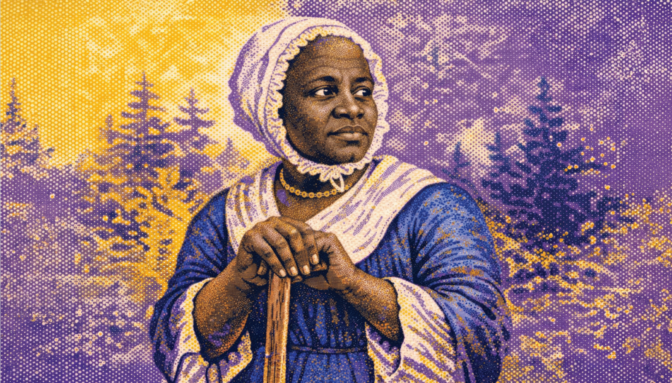
In this lesson, students explore the life of Elizabeth Freeman, an enslaved woman who won her freedom through the legal system during the Revolutionary War. Through close reading and character analysis, they examine how her curiosity and courage helped her challenge injustice while practicing evidence‐based discussion and writing skills.



Lesson Overview
In this lesson, students will explore the life of Elizabeth Freeman, an enslaved woman who won her freedom through the legal system during the Revolutionary War. Through close reading and character analysis, students will examine how Freeman’s character traits enabled her to challenge injustice and claim freedom for herself and others. Students will also practice generating thoughtful questions about character development and support their analysis with textual evidence. These activities will allow students to explore the ways in which Freeman demonstrated curiosity when she listened carefully to political discussions and learned about her constitutional rights.
Unit at a Glance
Unit Essential Questions
- The Declaration of Independence lists several self‐evident truths: People, by their very existence, are free, equal, and have rights. No one, not even a king, can govern them without their consent. What are freedom, equality, rights, and government with consent?
- To what extent were the women covered in these lessons able to use their character strengths to achieve the self‐evident truths outlined in the Declaration of Independence?
Objectives
- Identify character traits and analyze the development of a historical individual using textual evidence.
- Support claims using textual evidence in a structured written response.
- Formulate meaningful questions about the development of a historical individual in a nonfiction text.
- Collaborate with others to generate questions and share different perspectives about a nonfiction text.
Materials
- “Elizabeth Freeman and Her Legal Stand for Freedom” text
- Large sticky notes or large pieces of butcher paper
- Highlighters (one per student)
Warm‐Up
Post large sticky notes or poster papers around the room. Each one should be labeled with a character trait: Curiosity, Openness, Courage, Perseverance, and Determination. Have students walk around the room and write one example of this character trait from a story, a movie, or their own lives.
When all students have done this, have them walk silently around the classroom and read what the other students have written. Transition to the next activity by telling students they are going to explore the life of Elizabeth Freeman, a woman who displayed these character traits. Freeman was an enslaved woman at the time of the Founding who won her freedom by taking a legal stand.
Lesson Activities
READ ABOUT ELIZABETH FREEMAN
Hand out the text “Elizabeth Freeman and Her Legal Stand for Freedom.” Have students read the text individually or in pairs. While they are reading, ask them to annotate the text in the following ways:
- Highlight words and phrases that reveal Freeman’s identity. Remind students that Freeman’s identity can be determined by reading passages that describe what Freeman thinks of herself or what other individuals think of Freeman.
- Underline words and phrases that show Freeman’s actions. Tell students that these actions can be great or small. Each action in a text tells us, as readers, something about who the individual is.
- Star words and phrases that describe Freeman’s background. An individual’s background reveals a lot about their beliefs by telling us where and when they live, whom they care for, and what they pay attention to throughout their life.
SMALL GROUP QUESTIONS FOR DISCUSSION
After students have finished reading and annotating the passage, separate them into small groups. Ask each group to discuss the following questions, using evidence from the text to support their responses:
- What does Elizabeth Freeman believe about herself? What do others believe about Elizabeth Freeman?
- How do Elizabeth Freeman’s beliefs about herself mirror and/or conflict with the beliefs of others?
- How did Freeman change over the course of the text?
- What events or interactions sparked Freeman to act?
- What challenges did Freeman face, and how did she deal with them? What does this show about her character?
GENERATE QUESTIONS WITH A PARTNER
Have students pair up. Using the “Getting Curious About Historical Figures” table below, have students work together to generate questions about Elizabeth Freeman. Each question must begin with who, what, where, when, why, or how. To give students an example, you may share this question: “When did Freeman show the most courage?” At this point, students should only be filling in the “My questions” column.
GETTING CURIOUS ABOUT HISTORICAL FIGURES
While students are generating questions, walk around the room and help each pair write their own unique set of questions.
SHARE QUESTIONS
Pair students with different partners. Then ask each partner to share the questions they generated from the previous activity. Each partner should write the questions their partner generated in the “My partner’s questions” column of the table.
ANSWER QUESTIONS
After questions have been shared, students will choose two questions (one from each partner), and they will work together to answer these questions. Remind students to use evidence‐based responses in their answers. Write the following sentences on the board to guide their responses:
- Sentence 1: Restate the question as a statement and include your answer.
- Sentence 2: Share what part of the text demonstrates this.
- Sentence 3: Explain what this illustrates about the historical figure.
- Sentence 4: Connect this to what it represents or reminds you of in your own life, another text, or a current event/situation.
These responses should be recorded on a sheet of notebook paper.
DEBRIEF
After everyone has completed their tables, discuss the following questions with students as an entire class:
- Think about the questions you asked and the questions your partner asked. What did you notice about them? Were they similar? Were they different?
- What questions did your partner write that helped you learn more about Elizabeth Freeman? What did you learn that you hadn’t thought about before?
- Think about the character strengths of Elizabeth Freeman. What character traits did she have that were implied but not obvious? How did asking questions help you see these character traits?
Closing
As a whole group or individually, through an exit ticket, ask students the following questions:
- Why is it important to be curious about the individuals we read about?
- What did Elizabeth Freeman show us about the value of curiosity?
Published with permission of the Cato Institute © 2025.